

What is a Pneumatic Rotary Actuator?
A pneumatic rotary actuator is a mechanical device that converts the energy of compressed air into rotational motion. These actuators are an integral part of automated systems, particularly in industrial environments where remote or automated valve operation is essential. Unlike traditional electric motors or manual systems, pneumatic rotary actuators rely on the simplicity and reliability of compressed air to produce rotational force, making them suitable for applications in hazardous or demanding conditions.
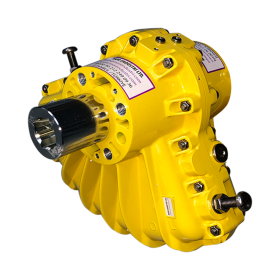 Working Principle of Pneumatic Rotary Actuators
The fundamental operation of a pneumatic rotary actuator is based on air pressure applied to an internal chamber. The actuator typically consists of one or more air chambers and a piston or a bellows diaphragm. When compressed air enters the chamber, it exerts force on the piston or diaphragm. Depending on the actuator design, this force can generate linear motion, which is subsequently converted into rotational motion through internal mechanisms such as racks and pinions or crank links. In other designs, the air directly causes rotational motion.
For example, in a quarter-turn actuator used to operate a ball valve, the piston’s linear movement is transformed into a 90-degree rotation, enabling the valve to open or close efficiently. Some pneumatic rotary actuators are designed for multi-turn valves, providing continuous or partial rotations, which are often required for more complex valve systems.
Components and Construction
A typical pneumatic rotary actuator includes several key components:
- Air chambers: The primary source of motion, these chambers receive pressurized air that drives the actuator.
- Piston or bellows diaphragm: Converts the air pressure into mechanical motion.
- Output shaft: Transfers rotational motion to the connected valve or device.
- Conversion mechanisms: In actuators where linear motion is produced first, components like racks, pinions, or crank mechanisms convert the linear movement into rotational torque.
- Seals and bearings: Ensure smooth operation and protect the internal components from contaminants or wear.
The design of pneumatic rotary actuators is optimized to provide high torque relative to their compact size. Unlike pneumatic cylinders, which are primarily linear actuators, rotary actuators are self-contained units that directly produce rotational motion. This reduces the need for additional linkages or pivot systems, simplifying installation and maintenance.
Applications in Industry
Pneumatic rotary actuators are widely used to automate and remotely control quarter-turn and multi-turn valves, including ball, butterfly, and plug valves. These actuators are especially valuable in environments where manual operation is impractical or unsafe. Industries such as chemical processing, water treatment, oil and gas, and food and beverage frequently rely on pneumatic rotary actuators due to their reliability and resistance to harsh conditions.
One of the key advantages of pneumatic rotary actuators is their ability to function in hazardous environments where sparks or electric motors could pose safety risks. Since the actuators operate using compressed air, they are inherently safe in flammable or explosive atmospheres. Additionally, the use of clean, dry air reduces the risk of contamination in sensitive processes.
Pneumatic rotary actuators can receive their compressed air from central air supply stations or, in some systems, from the process gas itself. The exhaust air from the actuator can be vented into the atmosphere or routed into a downstream low-pressure process line, allowing for integration into larger automated systems without causing contamination or pressure imbalances.
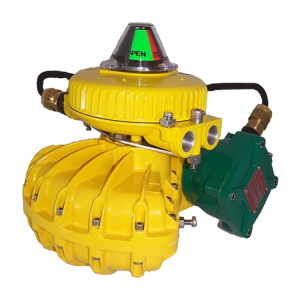
Advantages of Pneumatic Rotary Actuators
There are several advantages to using pneumatic rotary actuators:
- High force-to-size ratio: Despite their compact form, these actuators can generate significant torque, allowing them to operate valves and other equipment efficiently.
- Durability: The self-contained design protects internal components from contaminants and harsh environmental conditions, reducing maintenance requirements.
- Safety: Ideal for explosive or hazardous environments due to the absence of electrical components in the actuation system.
- Simplicity: Compared to converting linear motion from pneumatic cylinders to rotational motion, dedicated rotary actuators offer a streamlined and more reliable solution.
- Versatility: Suitable for a wide range of valve types and other rotational applications, making them highly adaptable in various industrial processes.
Design Considerations
When selecting a pneumatic rotary actuator, engineers must consider factors such as torque requirements, rotation angle, environmental conditions, and air supply characteristics. Some actuators provide spring-return functions, allowing the actuator to return to a default position in case of air supply failure. This feature is particularly useful in safety-critical applications.
Maintenance is generally minimal for pneumatic rotary actuators. Their self-contained design ensures that moving parts are protected from dust, moisture, and other contaminants, which significantly extends their operational life compared to systems that use external pivot mechanisms or linkages.
FAQs About Pneumatic Rotary Actuators
- What is the main difference between a pneumatic rotary actuator and a pneumatic cylinder?
A pneumatic cylinder produces linear motion, whereas a pneumatic rotary actuator directly produces rotational motion. While cylinders can be converted to rotary motion using linkages, rotary actuators are self-contained and more efficient for valve operations. - Can pneumatic rotary actuators be used in hazardous environments?
Yes. Since they operate on compressed air without electrical components, they are safe for flammable or explosive atmospheres. - What types of valves can a pneumatic rotary actuator operate?
These actuators are commonly used with ball, butterfly, plug, and other quarter-turn or multi-turn valves. - How is the motion generated in a pneumatic rotary actuator?
Compressed air acts on a piston or bellows diaphragm, creating linear or direct rotational motion. Linear motion is sometimes internally converted to rotation using mechanical linkages. - What are the advantages of using a pneumatic rotary actuator over a converted pneumatic cylinder?
Rotary actuators simplify design, reduce maintenance, offer higher durability, and provide a more compact and efficient solution for producing rotational torque. - Where does the exhaust air from a pneumatic rotary actuator go?
Exhaust air can be vented into the atmosphere or directed into a downstream low-pressure process pipeline, depending on the system design. - Are pneumatic rotary actuators suitable for continuous rotation applications?
Yes, certain designs are capable of multi-turn rotation, allowing them to control valves that require more than a simple quarter-turn.
